Top Semiconductor Trends in 2025: Insights from Industry Leaders

Introduction The semiconductor industry is poised for significant transformation by 2025, driven by advancements in technology, evolving market demands, and the need for sustainable practices. As the backbone of modern electronics, semiconductors play a crucial role in enabling innovations across various sectors, including artificial intelligence (AI), the Internet of Things (IoT), and automotive technologies. This… Continue reading Top Semiconductor Trends in 2025: Insights from Industry Leaders

How to Improve Efficiency in Global Fab Operations

In today’s semiconductor-driven world, the efficiency of global fabrication (fab) operations is more critical than ever. With rising demands from industries such as automotive, IoT, and AI, and the increasing complexity of advanced nodes, fabs must operate at peak performance to remain competitive. Let’s explore the strategies, technologies, and metrics that drive efficiency in this… Continue reading How to Improve Efficiency in Global Fab Operations

Exploring the Future of EUV Lithography and Beyond

In the world of semiconductor manufacturing, lithography is one of the most critical processes. As devices shrink to smaller nodes and manufacturers push beyond 7nm, lithography techniques are advancing to meet new challenges. One of the most promising technologies for achieving these miniaturization goals is Extreme Ultraviolet (EUV) lithography. This blog will explore the importance… Continue reading Exploring the Future of EUV Lithography and Beyond

How APC in Semiconductor Manufacturing Reduces Variability

In the competitive world of semiconductor manufacturing, the demand for higher efficiency, faster production cycles, and consistent quality is constantly increasing. Advanced Process Control (APC) has become a critical enabler to meet these demands by reducing variability, enhancing product quality, and improving yield. APC technologies, driven by real-time monitoring and advanced AI-driven systems, play a… Continue reading How APC in Semiconductor Manufacturing Reduces Variability

The Role of Quantum Dots in Semiconductor Evolution

As the semiconductor industry edges closer to the limits of Moore’s Law, quantum dot (QD) technology has emerged as a promising solution to enable smaller, more energy-efficient semiconductors. With their unique optical and electronic properties, quantum dots offer an exciting avenue for overcoming current node limitations and unlocking new potential in semiconductor design and performance.… Continue reading The Role of Quantum Dots in Semiconductor Evolution

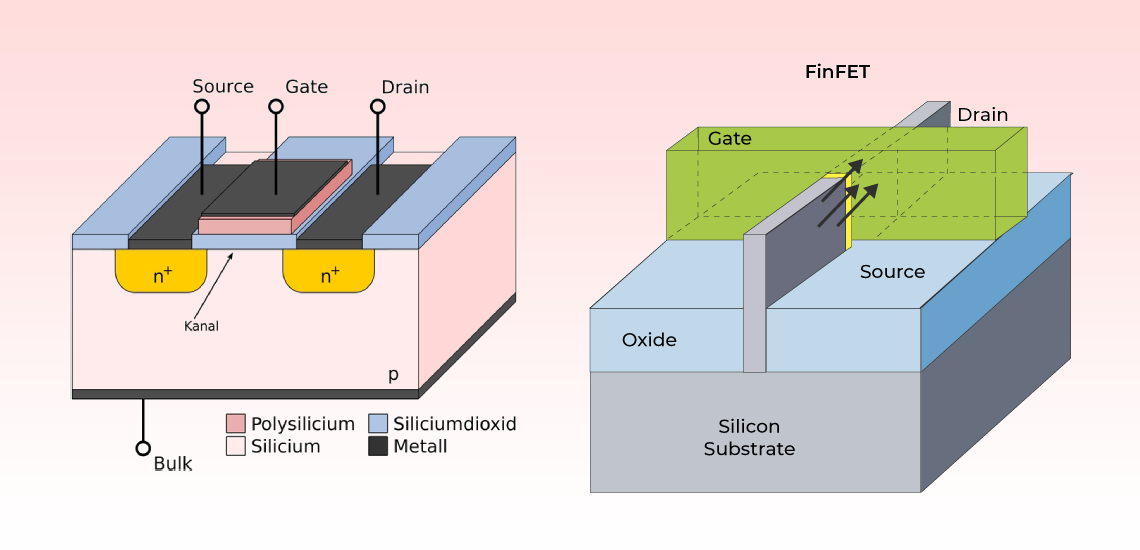
CMOS vs FinFET: Key Differences and Their Impact on Semiconductors

Transistor world is also a very interesting and evolving one. They are silent workhorses, manipulating the flow of electricity – a fundamental element upon which modern electronics have been built. But life is a complex system and in this Gordian web, the skirmish for effectiveness as well performance never cease Comparison between CMOS and FinFET.

How Advanced Manufacturing Techniques Are Shaping the Future of Semiconductors

The relentless march of technology hinges on ever-smaller, more powerful semiconductors. But as we reach the limits of traditional techniques, the industry is turning to cutting-edge solutions.

The Role of Automation in Revolutionizing Semiconductor Manufacturing

The world’s insatiable demand for faster, smaller, and more powerful chips hinges on the intricate ballet of semiconductor manufacturing. This symphony of precision requires a conductor – and increasingly, that conductor is automation.

Understanding FinFET Configurations: A Comprehensive Guide

The ever-shrinking world of electronics has driven a constant stream of innovation in transistor design. From the planar MOSFETs of the past to the finFETs of today, researchers have tirelessly focused on improving device performance and overcoming the hurdles that arise when making transistors ever smaller.

A Step-by-Step Guide to Semiconductor Manufacturing

Semiconductor chips, the brains behind modern technology, are marvels of miniaturization and engineering. Their intricate design and functionality rely on a complex manufacturing process with eight crucial steps. This article delves into each step, exploring the challenges, advancements, and potential areas for improvement.