


A leading semiconductor manufacturer required reliable remote FAB operations to maintain equipment qualification, monitor production activities, and minimize downtime without disrupting production.
To support these requirements, the customer needed a partner with expertise in semiconductor engineering services and remote FAB operations capable of maintaining production continuity while ensuring equipment qualification and process compliance.
 Semiconductor Engineering
 Remote FAB Operations
The objective was to establish a structured remote FAB operation model capable of supporting automated tool qualification, production operation monitoring, failure investigation, maintenance qualification, and production recovery while ensuring high equipment availability and uninterrupted manufacturing.
This project demonstrates how advanced Equipment Engineering Services and remote operational support can improve tool availability and manufacturing efficiency.
Equipment Engineering Services
The remote FAB operation model is built around two primary objectives, supported by structured processes and clear escalation paths.


Goal: Maximise tool availability, minimise downtime, and ensure smooth Production flow.
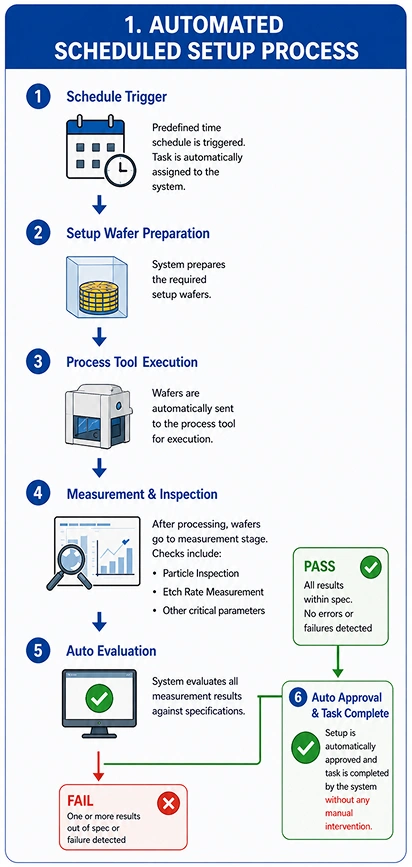
The automated tool qualification workflow ensures every production tool is verified before manufacturing resumes. The Automated Scheduled Setup Process runs automatically at a scheduled time, preparing and processing setup wafers without manual intervention. The system performs all required inspections and measurements, then evaluates the results against specifications. If all criteria are met, the setup is automatically approved and completed; otherwise, it is flagged for investigation and corrective action.


The Automated Scheduled Setup Process runs automatically at a scheduled time, preparing and processing setup wafers without manual intervention. The system performs all required inspections and measurements, then evaluates the results against specifications.
If all criteria are met, the setup is automatically approved and completed; otherwise, it is flagged for investigation and corrective action.
Auto-approved & completed — no manual intervention required
Flagged for investigation and corrective action
If any qualification measurement result fails to meet specifications, a task is automatically triggered to the Remote FAB Team for investigation and corrective action by following the SOP.
If any qualification measurement result fails to meet specifications, a task is automatically triggered to the Remote Fab Team for investigation and corrective action by following the SOP.
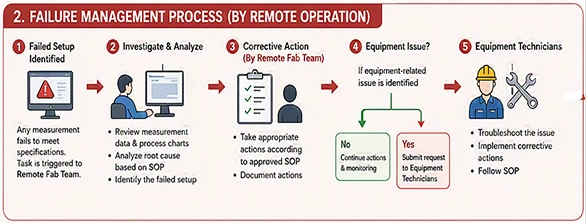
Immediately detect and document any qualification measurement that fails to meet specification limits.
Comprehensive review of all measurement data and process charts to understand the scope of the failure.
Systematic root cause analysis following the standard operating procedure.
Corrective actions implemented per the approved SOP to resolve the identified failure.
In the event of a setup qualification failure, the system will automatically place the affected tool in Inhibit Status (Fail) to prevent new production lots from being processed. This control is implemented to ensure product qualification and prevent potential risk.
Responsibilities include:
Assigning the setup lot to the appropriate tool.
Monitoring wafer processing throughout the entire flow.
Following up on all measurement and inspection steps.
Verifying that all measurement results meet specification requirements.
Ensuring the setup process is successfully completed.
Once all requirements are satisfied, the team completes the required checklist and formally closes the task.
Tool Recovery and Return to Production
Re-Run Setup Process (Re-Qualification)
After the corrective actions have been completed, the Remote FAB Team manually initiates the setup wafer re-run process for re-qualification. Responsibilities include:

Important: The tool inhibit must not be removed until the setup has successfully passed qualification. In addition, all qualification requirements and measurement data must be verified within the defined control limits before releasing the tool back to production.
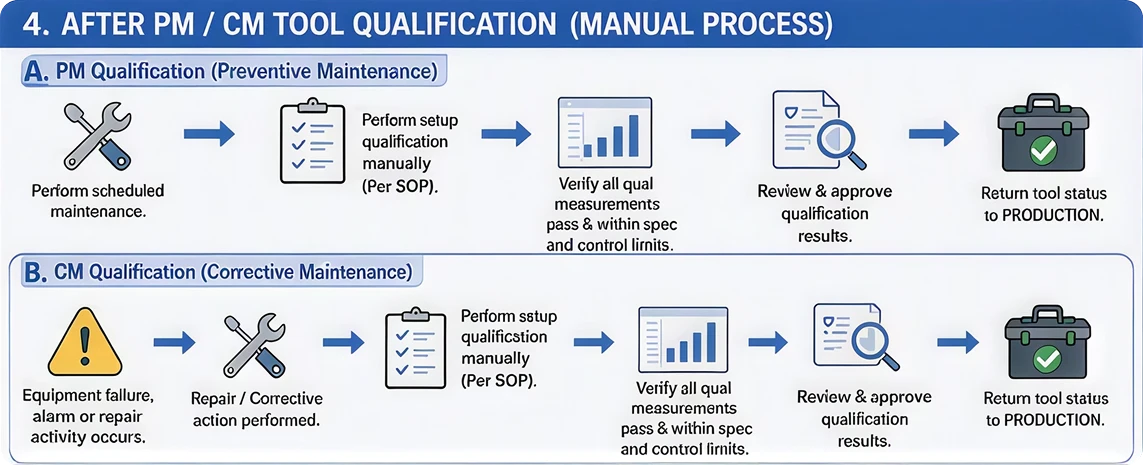
PM Qualification is performed after scheduled maintenance activities to verify that the equipment operates correctly and meets semiconductor production requirements.
As a result, production interruptions can be addressed quickly while maintaining manufacturing continuity.

PM Qualification (Preventive Maintenance): PM Qualification is performed after scheduled maintenance activities to verify that the equipment operates correctly and meets semiconductor production requirements.
Effective production operation monitoring enables the Remote FAB Team to quickly identify production holds, investigate root causes, monitor pilot lots, and coordinate timely issue resolution. As a result, semiconductor manufacturers can maintain smooth production flow, reduce downtime, and improve overall operational efficiency through structured remote FAB operations.
Smooth Production Flow
For example, after the lithography process is completed, pilot lots must undergo required measurements such as ADI, OVL, and CD.
If a lot is placed on hold for any reason, a task will be triggered to the remote FAB team. The issue must be promptly identified and resolved to ensure the lot continues to OVL Full Map measurement for data collection and is subsequently sent to Rework (RWK) in accordance with the applicable SOP.
Talk to our semiconductor engineering experts about remote FAB solutions.