
Can AI Solve the Semiconductor Talent Gap?
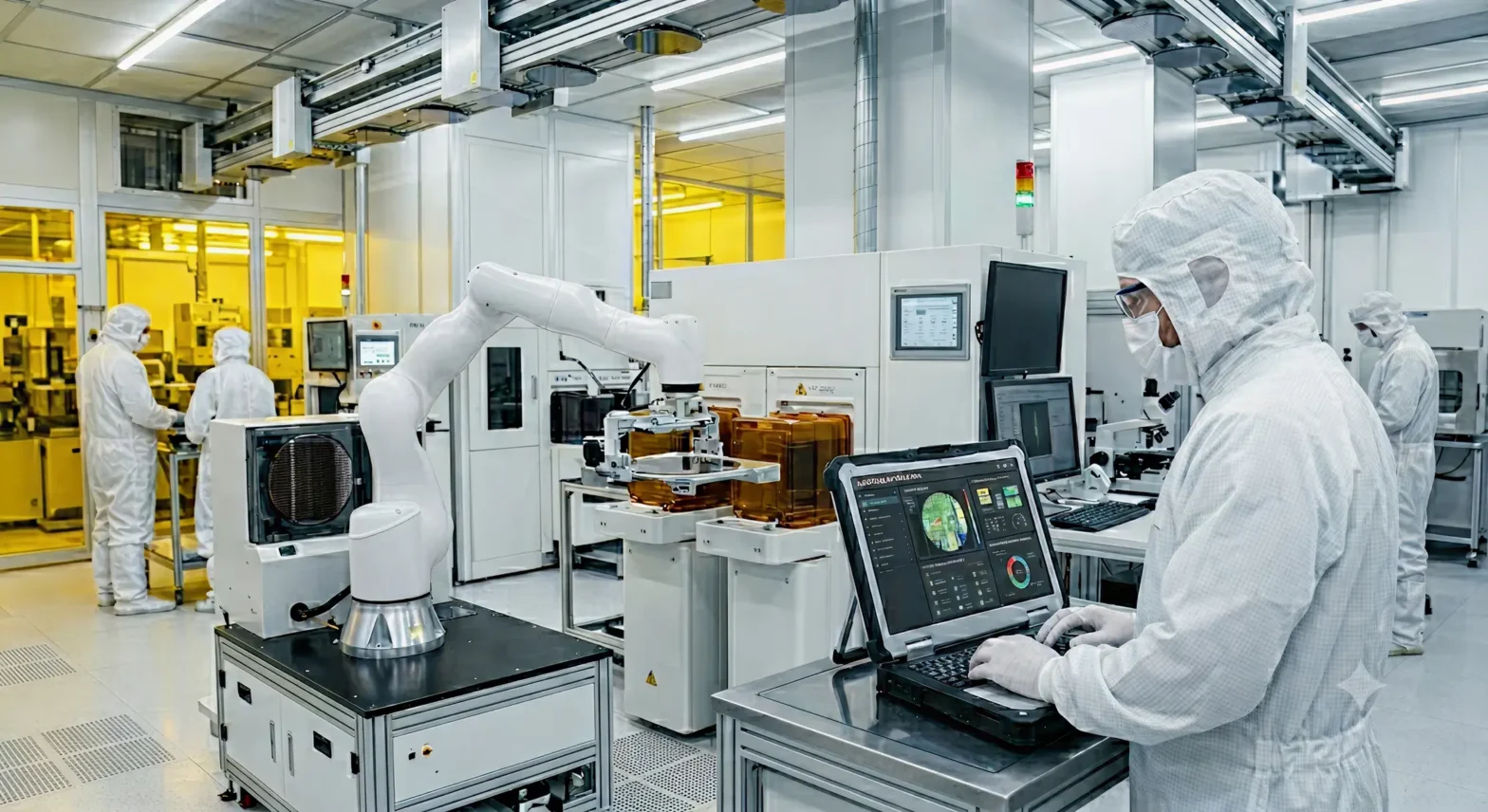
Can AI Solve the Semiconductor Talent Gap?
The rapid growth of artificial intelligence is driving unprecedented demand for semiconductors. From AI infrastructure and data centers to autonomous systems and advanced computing, nearly every emerginga technology depends on semiconductors. As global demand for advanced chips continues to rise, semiconductor manufacturers are under increasing pressure to expand production and improve efficiency. However, alongside this rapid growth, the industry is facing another major challenge: a widening semiconductor talent gap. According to Deloitte, the global semiconductor industry may require more than 1 million additional skilled workers by 2030 to support rising demand driven by AI, advanced computing, and global FAB expansion.
Modern semiconductor manufacturing is one of the world’s most complex and precision-driven industries, requiring highly skilled engineers, technicians, and process specialists to manage advanced FAB environments. However, as semiconductor FABs expand globally and manufacturing technologies become more sophisticated, the demand for specialised talent is outpacing supply. Workforce shortages are already affecting semiconductor manufacturing, maintenance, process engineering, and equipment servicing worldwide.
This is where artificial intelligence is beginning to make a significant impact. Across smart semiconductor FABs, AI-driven systems are helping automate repetitive tasks, improve predictive maintenance, accelerate defect detection, and support faster operational decision-making. While AI cannot replace semiconductor expertise, it is becoming a valuable tool for improving efficiency amid growing workforce challenges.
So, can AI solve the semiconductor talent gap, or will the future of semiconductor manufacturing depend on a balance between human expertise and intelligent automation? As AI continues to reshape global industries, the answer could define the future of semiconductor manufacturing.
Why the Semiconductor Industry Is Facing a Talent Shortage
The global semiconductor industry is expanding faster than ever before. Driven by the rapid growth of artificial intelligence, electric vehicles, high-performance computing, data centers, and consumer electronics, chip demand has reached unprecedented levels. McKinsey reports that semiconductor job postings for technical roles in the U.S. and Europe grew by more than 75% annually between 2018 and 2022 as the industry scaled rapidly. Governments and technology companies worldwide are investing billions of dollars into new semiconductor FABs and manufacturing facilities to strengthen supply chains and meet future demand. However, while infrastructure is growing rapidly, the availability of skilled semiconductor talent is struggling to keep pace.
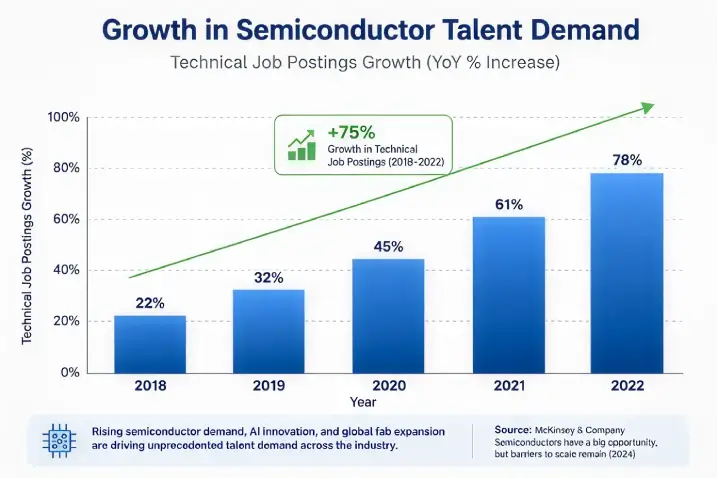
Growth in Semiconductor Talent Demand
One of the main reasons behind the semiconductor workforce shortage is the highly specialised nature of semiconductor manufacturing. Unlike traditional manufacturing industries, semiconductor FABs require expertise in process engineering, wafer fabrication, equipment maintenance, contamination control, automation, and advanced materials. Building semiconductor expertise requires years of specialised technical training and hands-on fab experience.
Advanced chip production is also becoming more complex. Advanced chip technologies now involve smaller process nodes, sophisticated packaging methods, and highly automated production environments. As FABs adopt smart manufacturing and AI-driven operations, demand is growing for professionals who understand both semiconductor engineering and digital technologies. As fabs become more automated and data-driven, demand for digitally skilled engineers is rising faster than the available talent pipeline.
| Challenge | Industry Impact |
|---|---|
| Rapid FAB expansion | Increased demand for engineers and technicians |
| Aging workforce | Loss of experienced expertise |
| AI-driven manufacturing complexity | Need for specialised digital skills |
| Competition from the software industry | Reduced semiconductor talent pipeline |
| Global semiconductor investments | Higher hiring competition worldwide |
Table 1 – Key Drivers Behind the Semiconductor Talent Gap
Key Drivers Behind the Semiconductor Talent Gap
Another major factor behind the semiconductor talent gap is the rapid pace of global FAB expansion. Governments worldwide are investing heavily in semiconductor manufacturing to strengthen domestic chip production and supply chain resilience. Global fab expansion is intensifying competition for experienced semiconductor professionals across the industry.
The industry is also facing demographic challenges. Many experienced semiconductor engineers are approaching retirement, raising concerns around workforce continuity and knowledge transfer. Moreover, younger talent is often more attracted to software, AI startups, and digital industries, leaving semiconductor manufacturing with a smaller talent pipeline.
As semiconductors become increasingly critical to AI and global technology infrastructure, addressing the semiconductor workforce shortage has evolved from a hiring challenge into a strategic industry priority.
How AI Is Transforming Semiconductor Manufacturing
As semiconductor manufacturing becomes more advanced and data-intensive, artificial intelligence is emerging as a critical tool for improving efficiency, precision, and operational reliability inside modern FABs. Semiconductor production involves thousands of highly controlled processes where even minor defects, contamination issues, or equipment failures can impact yield and increase production cos
Modern semiconductor FABs also generate enormous volumes of operational data daily, making AI and machine learning essential for process optimisation, predictive maintenance, defect detection, and yield improvement. As smart manufacturing expands, AI is helping semiconductor companies build faster, more efficient, and increasingly resilient FAB environments.
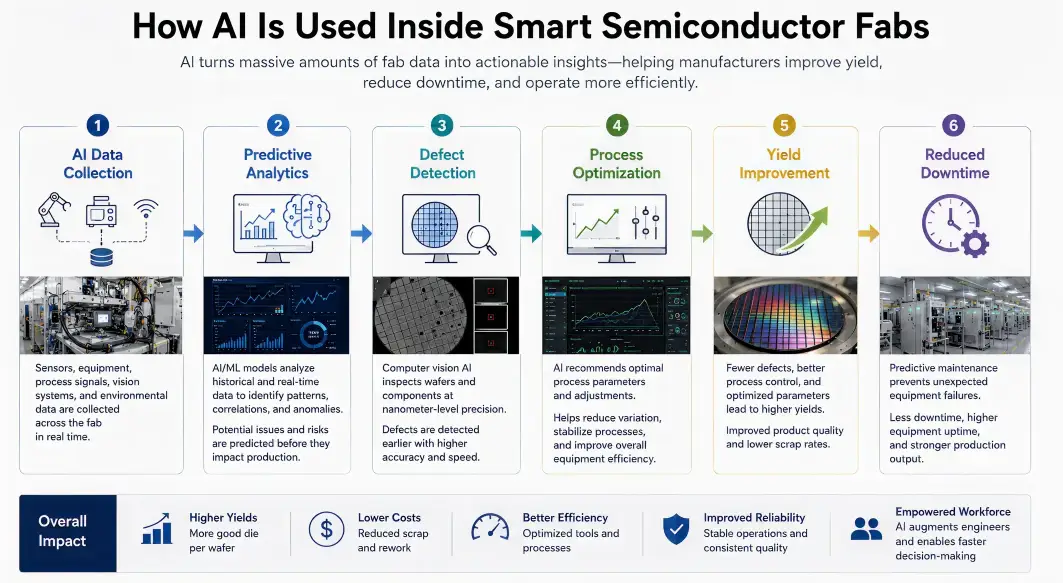
How AI Accelerates Semiconductor Workforce Training
One of the most impactful applications of AI in semiconductor manufacturing is predictive maintenance. AI-powered monitoring systems can analyse equipment data in real time, detect abnormal performance patterns, and predict potential failures before they occur. This helps fabs reduce costly production interruptions and maintain more stable manufacturing operations.
AI is also transforming defect detection and quality inspection across semiconductor FABs. Traditional inspection methods often rely on manual analysis and rule-based systems, which become harder to manage as chip architectures grow more complex. Today, AI-powered inspection systems can identify microscopic wafer defects in real time, improving yield while reducing manual inspection workloads. This improves yield optimisation while reducing production waste and costly rework.
Another major area where AI is driving change is process optimisation. Semiconductor fabs generate enormous amounts of production data, and AI-driven analytics can help identify inefficiencies, improve process stability, and support faster decision-making. In smart semiconductor FABs, AI helps engineers optimise production parameters, monitor environmental conditions, and helps engineers detect process variation earlier.
AI-driven automation is also helping address workforce challenges within the semiconductor industry. By supporting tasks such as equipment monitoring, fault detection, scheduling, and data analysis, AI allows engineers and technicians to focus more on strategic problem-solving and operational improvements rather than repetitive manual tasks.
| AI Application | Operational Benefit |
|---|---|
| Predictive maintenance | Reduced equipment downtime |
| Computer vision inspection | Faster defect detection |
| Process optimization | Improved yield stability |
| AI-driven analytics | Faster decision-making |
| Smart automation | Reduced manual workload |
Table-2 – Key AI Applications in Semiconductor Manufacturing
AI Applications in Semiconductor Manufacturing
As demand for advanced chips continues to grow alongside the expansion of artificial intelligence technologies, smart semiconductor manufacturing is expected to become even more dependent on AI-driven operations. From predictive analytics and intelligent automation to yield improvement and real-time process monitoring, AI is helping semiconductor manufacturers build faster, smarter, and more resilient FABs for the future.
Can AI Help Bridge the Semiconductor Workforce Gap?
As semiconductor manufacturers work to meet rising global demand, the industry is under increasing pressure to maintain efficiency despite ongoing workforce shortages. From equipment maintenance and process engineering to inspection and data analysis, many semiconductor operations require highly specialised expertise that is becoming increasingly difficult to scale. To address these challenges, companies are turning to artificial intelligence to improve workforce productivity and optimise FAB operations.
AI is not replacing semiconductor professionals, but it is helping manufacturers automate repetitive tasks, improve operational visibility, accelerate training, and support faster decision-making across smart semiconductor FABs. AI-driven systems are enabling teams to work more efficiently while reducing the operational burden on engineers and technicians.
From predictive maintenance and intelligent automation to AI-assisted training and advanced analytics, artificial intelligence is beginning to reshape how semiconductor manufacturing teams operate and collaborate. Here are some of the key ways AI is helping bridge the semiconductor workforce gap.
1. Predictive Maintenance:
- In semiconductor manufacturing, even a brief equipment failure can disrupt production schedules, impact wafer yield, and lead
to high operational costs. - Traditionally, maintenance teams relied heavily on manual monitoring and scheduled inspections to identify potential equipment
issues. - However, as semiconductor FABs become more complex and production volumes increase, this reactive approach is becoming
increasingly difficult to sustain.
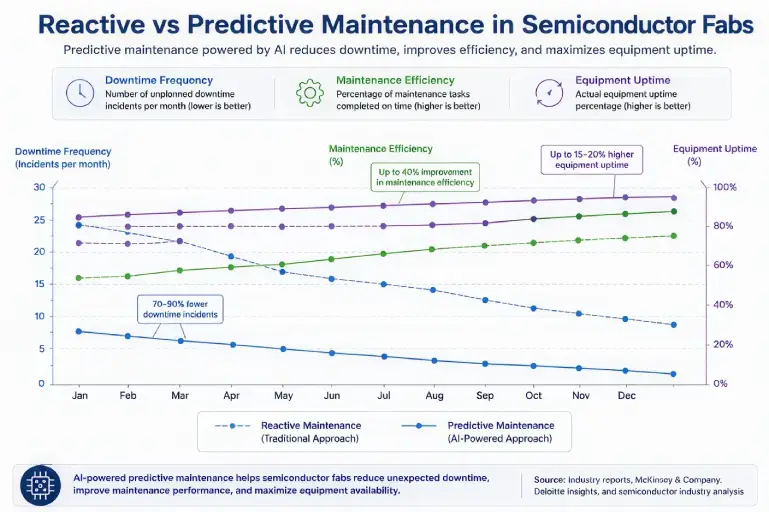
AI-powered predictive maintenance is helping semiconductor manufacturers shift from reactive maintenance to a more proactive and data-driven approach. By analysing real-time equipment data, sensor readings, vibration patterns, and operational metrics, AI systems can identify early signs of equipment degradation before failures occur. This enables maintenance teams to resolve issues earlier while reducing the need for constant manual monitoring across FAB operations.
One of the biggest operational benefits is faster issue detection. AI algorithms can recognise abnormal patterns that may be difficult for human operators to detect within equipment performance data, allowing engineers to respond more quickly and accurately. As a result, semiconductor manufacturers can reduce unplanned downtime, improve equipment uptime, and maintain more stable production environments — all critical factors in high-precision semiconductor FABs.
2. Training and Knowledge Transfer:
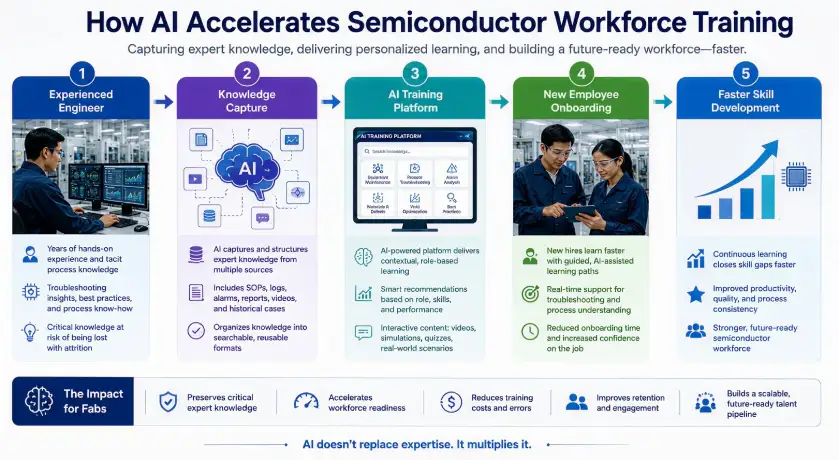
One of the semiconductor industry’s biggest workforce challenges is the widening gap between experienced professionals and incoming talent. Semiconductor manufacturing depends heavily on specialised technical expertise that often takes years of hands-on experience to develop. As experienced engineers and technicians retire, companies face growing pressure to preserve critical operational knowledge while accelerating workforce training for new employees.
AI-assisted training systems are beginning to play an important role in addressing this challenge. Intelligent learning platforms can simplify onboarding through guided troubleshooting support, interactive training modules, and real-time operational insights. AI-based learning platforms can accelerate onboarding through guided troubleshooting support and interactive digital training.
AI is also helping semiconductor manufacturers capture and organise expert knowledge that could otherwise be lost over time. In many semiconductor FABs, experienced engineers have critical engineering knowledge related to equipment behaviour, maintenance patterns, and manufacturing optimisation. AI-driven knowledge management systems can document troubleshooting data, maintenance records, and operational insights, making critical expertise more accessible to future teams.
As semiconductor manufacturing continues to evolve, AI-assisted learning and knowledge transfer could become essential for building a more scalable and resilient workforce pipeline.
3. Automation in Repetitive FAB Operations:
Semiconductor fabs rely on continuous inspection, monitoring, diagnostics, and data analysis to maintain yield and product quality.
AI-driven automation is helping semiconductor FABs streamline many of these repetitive tasks. In wafer inspection, for example, AI-powered computer vision systems can analyse wafer surfaces at high speeds and identify microscopic defects more efficiently than traditional manual inspection methods. This improves inspection accuracy while reducing the workload on engineers and quality control teams.
AI systems are also improving real-time monitoring across FAB environments. Smart monitoring platforms can continuously track equipment performance, process conditions, contamination risks, and production metrics, allowing manufacturers to respond to issues more proactively. Automated data analysis further helps teams process large volumes of operational data faster, reducing the time spent on manual reporting and routine diagnostics.
By automating repetitive and data-intensive tasks, semiconductor manufacturers can improve operational consistency, optimise workforce allocation, and enabling engineers to focus on higher-value problem-solving and process optimisation.
| Traditional FAB Operations | AI-Assisted FAB Operations |
|---|---|
| Manual inspection | AI-powered computer vision |
| Periodic monitoring | Real-time monitoring |
| Manual diagnostics | Automated diagnostics |
| Time-intensive reporting | AI-driven analytics |
Table-3 – Traditional vs AI-Assisted Fab Operations
4. Decision Support for Engineers:
Modern semiconductor FABs generate enormous amounts of operational and process data every day. As manufacturing processes become more advanced and interconnected, interpreting this data efficiently is becoming increasingly challenging. AI-driven decision support systems are helping engineers make faster, more informed decisions by turning complex datasets into faster engineering decisions.
One of the most valuable benefits of AI in semiconductor manufacturing is faster troubleshooting. When process deviations or equipment issues occur, AI systems can quickly analyse historical performance patterns, identify potential root causes, and recommend corrective actions. This helps reduce troubleshooting time and minimise production disruptions.
AI is also improving data interpretation and yield analysis across semiconductor FABs. Machine learning models can identify hidden process variations, detect subtle production trends, and support engineers in optimising manufacturing parameters for improved yield performance. Even small yield improvements can significantly reduce manufacturing costs.
Beyond technical optimisation, AI-driven insights are helping FABs improve overall operational efficiency. From production scheduling and resource allocation to maintenance planning and process control, AI enables engineers and operations teams to make faster and more strategic decisions.
Rather than replacing engineers, AI is increasingly serving as a decision-support tool that enhances human expertise and helps semiconductor professionals manage complex manufacturing environments more effectively.
The Limits of AI in Semiconductor Manufacturing
While artificial intelligence is transforming semiconductor manufacturing, it is not a complete solution to the industry’s workforce challenges. Semiconductor FABs remain some of the most complex and precision-driven manufacturing environments, requiring deep technical expertise, operational experience, and human decision-making that AI alone cannot fully replicate. According to McKinsey, semiconductor talent shortages are being intensified by an ageing workforce, increasing manufacturing complexity, and limited technical talent pipelines globally.
One of the biggest misconceptions surrounding AI in manufacturing is the idea that automation can fully replace skilled professionals. Semiconductor production still depends heavily on highly trained engineers, technicians, and equipment specialists who understand complex process interactions, yield optimisation, contamination control, and advanced manufacturing systems. While AI can improve efficiency and reduce manual workloads, critical engineering decisions still require human expertise and judgment.
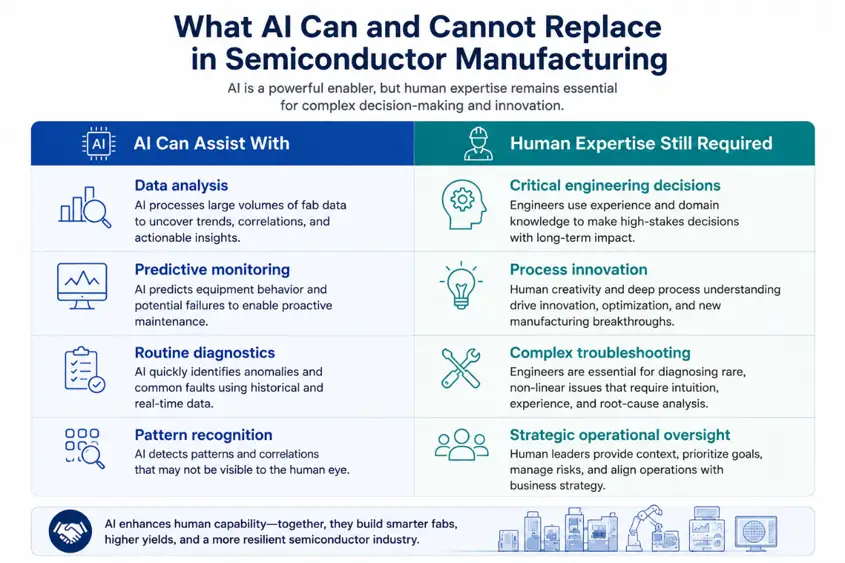
Human oversight remains essential in semiconductor manufacturing. While AI systems can identify patterns and recommend actions, engineers are still responsible for validating outputs, managing process risks, and making critical manufacturing decisions. In high-precision FAB environments, even small process deviations can impact yield and product reliability.
AI systems also depend heavily on high-quality data. Inconsistent or incomplete datasets can reduce prediction accuracy, making strong data infrastructure and continuous monitoring essential for successful AI implementation.
AI is best viewed as a tool that enhances semiconductor expertise rather than replaces it. The future of semiconductor manufacturing will depend on combining intelligent automation with skilled engineering talent.
The Future of Semiconductor Talent in the AI Era.
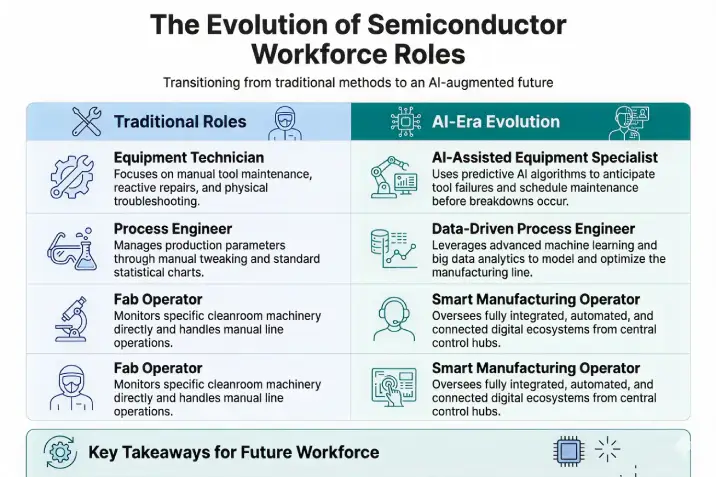
As artificial intelligence continues to reshape semiconductor manufacturing, the semiconductor workforce is evolving as well. Rather than replacing human talent, AI is changing the skills and roles required inside modern semiconductor FABs manufacturing environments.
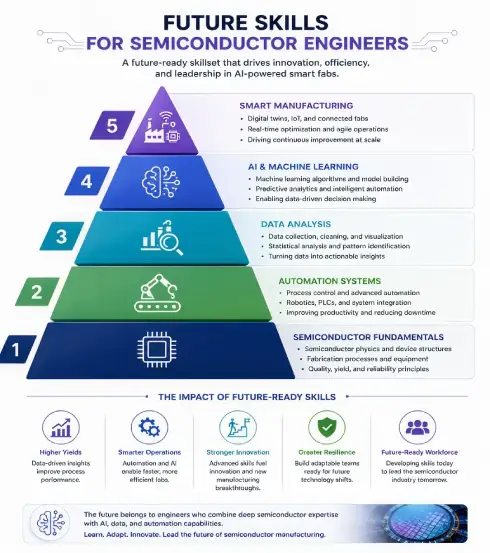
Many traditional semiconductor roles are becoming increasingly technology-driven. Engineers are now expected to work alongside automation systems, interpret operational data, and manage digital manufacturing environments in addition to traditional process and equipment responsibilities.
As smart semiconductor FABs become more common, demand for professionals with expertise in both semiconductor manufacturing and AI-driven technologies is expected to grow significantly. Deloitte projects the semiconductor industry could exceed $1 trillion in revenue by 2030, further increasing demand for AI- and automation-skilled engineers.
As a result, demand for AI-literate semiconductor professionals is continuing to rise. Future workforce skills may increasingly include data analysis, automation systems, machine learning fundamentals, and digital manufacturing technologies alongside traditional engineering expertise. To support this shift, semiconductor companies and educational institutions will need to invest more heavily in workforce development, training, and upskilling initiatives for AI-driven manufacturing environments.
As the semiconductor industry expands to support AI, advanced computing, and next-generation technologies, companies that successfully combine skilled talent with intelligent automation may be best positioned for long-term growth. In the AI era, the future of semiconductor manufacturing will depend not only on advanced chips and smart FABs, but also on building a workforce capable of adapting to rapidly evolving technologies.
Bridging the Semiconductor Talent Gap
The semiconductor talent gap cannot be addressed through automation alone. The industry also needs experienced engineers who can support critical manufacturing and engineering operations. Orbit & Skyline is helping address this challenge by providing semiconductor engineering talent to support global semiconductor organisations. Our professionals bring hands-on industry experience to complex semiconductor environments, helping companies strengthen their engineering capabilities as demand for advanced technologies continues to grow.
Conclusion
As global demand for semiconductors and AI continues to grow, the semiconductor industry faces a major challenge: scaling manufacturing while addressing a persistent talent shortage. From process engineering and equipment maintenance to FAB operations and yield optimisation, semiconductor manufacturing still depends heavily on highly skilled professionals.
Rather than replacing semiconductor talent, AI is helping manufacturers improve efficiency through predictive maintenance, automation, faster data analysis, and smarter decision-making across semiconductor FABs. This allows engineers and technicians to focus more on innovation and complex problem-solving.
At the same time, smart manufacturing is reshaping the future semiconductor workforce. As FABs become increasingly data-driven and AI-enabled, demand for professionals with expertise in both semiconductor manufacturing and digital technologies will continue to rise. Ultimately, solving the semiconductor talent gap will require a balance between skilled talent, workforce development, and AI-driven manufacturing innovation.
With 15+ years of expertise and a global team of 600+ engineers, Orbit & Skyline supports semiconductor manufacturers with advanced engineering services, equipment support, and operational solutions tailored for the evolving semiconductor industry. To learn more, connect with our team at hello@orbitskyline.com.
References
- Deloitte. (2024). Global semiconductor talent shortage: How to solve semiconductor workforce challenges. Deloitte Insights. Deloitte Global Semiconductor Talent Shortage Report
- Deloitte. (2024). Semiconductor workforce development strategies: Addressing the global talent shortage. Deloitte Insights. Deloitte Semiconductor Workforce Development Strategies
- McKinsey & Company. (2024, February 2). How semiconductor companies can fill the expanding talent gap. McKinsey Semiconductor Talent Gap Article
- McKinsey & Company. (2024, August 2). Reimagining labour to close the expanding US semiconductor talent gap. McKinsey Reimagining Labour in the Semiconductor Industry
- McKinsey & Company. (2024). Semiconductors have a big opportunity, but barriers to scale remain. McKinsey Semiconductor Industry Growth Insights

 Semiconductor FAB Solutions
 OEM Solutions